DealCheck vs Tranchi AI: Long- & Short-Term Investment Analysis
You are comparing two tools for the same job: deciding whether a property makes money. One finds the deal and underwrites it; the other expects you to bring the numbers. That difference shapes your entire workflow.
By the end, you will know how Tranchi AI's 44 AI Agents source deals versus DealCheck's manual entry, how each handles short and long term analysis, and which fits your budget and goals. The verdict is specific.
Quick Verdict: DealCheck vs Tranchi AI for Long- & Short-Term Investment Analysis
If you need to analyze deals fast and want AI to handle sourcing, underwriting, and execution, Tranchi AI is the clear winner; if you prefer a hands-on calculator for property evaluation, DealCheck may suffice.
The two tools sit in different categories. DealCheck is a traditional property analysis calculator built for number crunching. Tranchi AI is a full-stack AI platform that goes well beyond analysis into sourcing and execution.
That distinction matters most when you are evaluating both long-term rentals and short-term rentals such as Airbnb or VRBO listings. A calculator helps you check the math on a deal you already found. An AI-powered platform can help you find the deal in the first place.
| Factor | Tranchi AI | DealCheck |
|---|---|---|
| Category | Full-stack AI platform | Traditional analysis tool |
| Deal sourcing | 44 AI agents scan hidden databases | Not its focus |
| Automation | Handles 95% of real estate work | Manual input driven |
| Data sources | Probate filings, auctions, government sites | User-supplied deal data |
| Track record | 5.0 rating, 2,742+ users | General market presence |
Tranchi AI carries a 5.0 rating and is used by 2,742+ users to generate an extra $20K/mo. Its 44 different AI agents handle 95% of real estate work, and its proprietary workflows scan millions of probate court filings, auction websites, and government websites.
DealCheck, by contrast, is best understood generally as a property evaluation calculator. It can support cash flow, cap rate, and ROI estimates when you feed it the right inputs, but sourcing and execution stay on your plate.
For long-term rental investors weighing mortgage amortization, property tax, insurance, vacancy rate, maintenance costs, and property management fees, either tool can help with the math. Only Tranchi AI also scans the market for opportunities.
For short-term rental investors modeling Airbnb or VRBO income, occupancy swings and operating expenses make fast iteration valuable. Tranchi AI's automation keeps that process moving without manual data entry at every step.
Bottom line: choose Tranchi AI if you want sourcing, underwriting, and execution in one AI-powered platform. Choose DealCheck only if a standalone calculator matches how you prefer to work.
At a glance: how Tranchi AI compares to DealCheck on the features that matter most.
| Feature | Tranchi AI | DealCheck |
|---|---|---|
| Comprehensive Analysis for Long-Term and Short-Term Real Estate Investments | ✓ | ✓ |
What Is Tranchi AI?

Tranchi AI is a collection of 44 AI agents that scan hidden government databases, auction sites, and off-market listings to find profitable real estate deals. Rather than relying on a single search tool, the platform deploys dozens of specialized agents that work in parallel to surface opportunities most investors would never find on their own.
The platform is a SaaS product built to handle 95% of the work for real estate investors. That includes the full arc of a deal: sourcing properties, underwriting them, arranging funding, and automating the transaction itself. For anyone who has spent weeks manually filtering listings and building spreadsheets, the appeal is obvious. Tranchi AI is designed to save users hundreds of hours of searching, time that would otherwise go into repetitive research rather than decision-making.
Because it runs entirely online, Tranchi AI is available globally. Investors in any market can access the same agent-driven workflow without installing desktop software or committing to a regional data provider. This matters for buyers who want to evaluate deals across multiple states or countries, where local listing platforms rarely overlap.
The platform is built for a broad audience. It suits experienced real estate investors looking to scale, beginners making their first purchase, and small business owners who want to generate passive income through property. Importantly, no AI experience is required. The agents handle the technical heavy lifting, so users interact with results rather than prompts or models.
Beyond the software itself, Tranchi AI offers direct access to its founders. Yazan, Marc, and Deeb provide 1-on-1 coaching, giving users a human layer on top of the automated workflow. For beginners especially, that combination of agent-driven deal sourcing and personal guidance covers both the technical and strategic sides of investing.
In practical terms, the platform's four core functions break down cleanly:
- Deal sourcing: 44 AI agents scan government databases, auction sites, and off-market listings for profitable opportunities.
- Underwriting: properties are evaluated within the platform, reducing manual spreadsheet work.
- Funding: the workflow extends into arranging capital for a deal.
- Transaction automation: steps through the closing process are automated to cut administrative overhead.
The underlying goal is passive income through real estate, with the platform absorbing the repetitive work that typically slows investors down. Instead of juggling separate tools for searching, analysis, and financing, users work inside a single environment where each stage feeds the next.
What Is DealCheck?
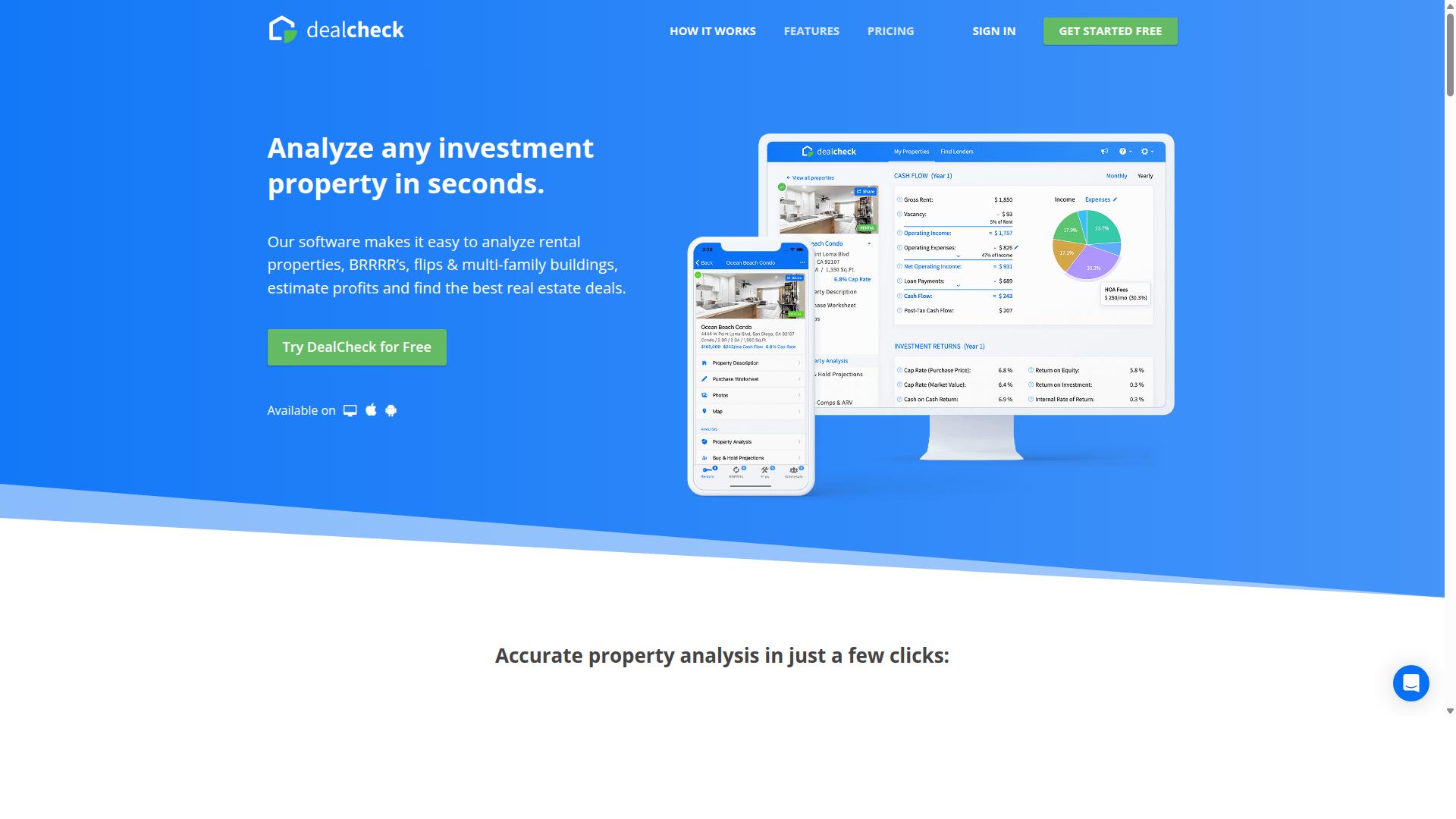
DealCheck is a real estate analysis software that helps investors evaluate properties through calculators for cash flow, cap rate, ROI, and other metrics. It is generally positioned as a traditional deal analysis tool, meaning the investor enters the numbers and the software organizes them into reports.
The platform is commonly associated with rental property calculator features. These typically let a user input purchase price, down payment, financing terms, and projected rent, then view the resulting income and expense picture.
Its core audience appears to be individual investors, agents, and small teams who want a structured way to screen deals before committing capital. The appeal is consistency: the same inputs produce the same output format every time.
A typical DealCheck-style workflow includes several standard inputs and outputs:
- Income inputs: monthly rent, other income, and a vacancy rate assumption
- Operating expenses: property tax, insurance, maintenance, property management fees, and HOA fees
- Financing details: interest rate, loan term, down payment, and closing costs
- Output metrics: cash flow, cap rate, ROI, net operating income, and amortization schedules
Many versions of this type of tool also include a comparative market analysis view and a rent estimate feature, which help an investor sanity-check assumptions against local market data.
Because these tools rely on manual entry, the quality of the analysis depends heavily on how accurate the user's assumptions are. Small errors in vacancy rate or maintenance costs can meaningfully shift the projected return.
DealCheck also tends to support both long-term rental and short-term rental scenarios, including Airbnb and VRBO style projections, though the depth of short-term modeling can vary by plan.
For investors comparing tools, the practical questions are straightforward. How fast can a deal be screened? How well does the software handle both long-term and short-term rental assumptions? And how much manual data entry is required before a usable answer appears?
DealCheck answers those questions in a conventional way: structured forms, calculator-driven outputs, and report-style summaries. It is a solid baseline for traditional investment analysis, and understanding that baseline makes it easier to see where newer, AI-powered platforms differ.
Features Compared
When comparing features, Tranchi AI offers end-to-end automation with 44 AI agents, while DealCheck focuses on manual analysis tools. The two platforms sit at opposite ends of the real estate software spectrum: one aims to run the entire deal lifecycle, the other equips investors to evaluate properties themselves.
This comparison covers three categories that matter most to long-term and short-term rental investors: deal sourcing, analysis depth, and execution capabilities. Each category reveals a different trade-off between hands-on control and automated speed.
Understanding where each platform invests its engineering effort helps investors decide which fits their strategy. A buy-and-hold investor running a rental property calculator may value one approach, while an investor chasing off-market opportunities may prefer the other.
Deal Sourcing: 44 AI Agents Scanning Hidden Databases vs Manual Deal Entry
Tranchi AI's 44 AI agents automatically scan millions of probate court filings, auction websites, and off-market listings to surface profitable deals, whereas DealCheck requires manual entry of property data. The Off-Market Deal Scanner, Probate Opportunity Scraper, County Foreclosure Monitoring, and Tax Deed Opportunity Scanner work together to find opportunities that never appear on the mainstream market.
For investors, the difference is time. Tranchi AI handles roughly 95% of the work, saving hours that would otherwise go into searching listing sites, courthouse records, and auction platforms by hand.
Consider a typical week for a busy investor. With Tranchi AI, agents surface probate filings and auction listings, flag candidates using Rent-to-Price Ratio Detection, and present deals ready for review. With DealCheck, the investor must first find those properties elsewhere, then key in details one by one before any analysis begins.
DealCheck's approach is not flawed, it is simply manual. Investors who already have a pipeline of properties can enter them into DealCheck for evaluation. But for those who need deal flow generated for them, the sourcing gap is significant.
- Tranchi AI: automated scanning of probate filings, auctions, foreclosures, and off-market listings
- DealCheck: manual entry of property data sourced by the user
- Time impact: Tranchi AI removes the search phase; DealCheck begins after it
Analysis Depth: AI Underwriting Engine vs Traditional Calculator Tools
Tranchi AI's AI Underwriting Engine automatically calculates cash flow, cap rate, ROI, and other metrics, while DealCheck relies on user-inputted assumptions in traditional calculators. The engine factors in operating expenses, mortgage calculations, vacancy rates, and more without requiring the investor to assemble each variable manually.
DealCheck's calculator tools are capable, but they depend on the user supplying interest rate, loan term, property tax, insurance, maintenance costs, property management fees, HOA fees, closing costs, and down payment figures. Every assumption must be researched and entered correctly, and an error in any field distorts the output.
Tranchi AI's automation reduces that risk. Because the platform supports All Deal Types & Unlimited Analysis, investors can evaluate long-term rentals, short-term rentals, Airbnb and VRBO candidates, and flips without rebuilding a model each time.
The practical difference shows up in comparison work. An investor weighing three properties can run each through DealCheck calculators, entering assumptions three times, or let the AI Underwriting Engine produce net operating income, internal rate of return, and amortization projections automatically.
| Feature | Tranchi AI | DealCheck |
|---|---|---|
| Metric calculation | Automated via AI Underwriting Engine | Manual entry in calculators |
| Assumption inputs | Handled by the platform | User supplies rates, taxes, fees, and costs |
| Deal types | All Deal Types & Unlimited Analysis | Depends on selected calculator |
For investors who value speed and consistency across many property evaluations, the automated route leaves less room for human error.
End-to-End Execution: Outreach, Funding & Transaction Automation vs Analysis-Only Workflow
Tranchi AI goes beyond analysis by automating outreach, funding, and transaction processes, whereas DealCheck stops at property evaluation. Execution Agents, the Automated Funding System, and the Transaction Automation Layer carry a deal from first contact through closing.
Seller Outreach Automation and Acquisition Bots initiate contact with property owners. AI-Assisted Offer Negotiation and Automated Term Sheet Generation move the conversation toward a signed agreement. Capital Stack Structuring and the Loan Officer Bot support the financing stage, while the Transaction Coordinator Bot manages the closing workflow.
This is where transaction automation changes an investor's week. Manual follow-ups with sellers, lenders, and title companies consume hours. Tranchi AI's end-to-end approach keeps those steps moving without the investor chasing each one.
DealCheck's analysis-only workflow is a fair fit for investors who already have their own outreach, financing, and closing systems in place. But for those building a portfolio, the execution layer is often the difference between finding a deal and actually closing it.
Supporting resources extend the platform further. A 20-Hour Course covers Contract Flipping, BRRRR, Turnkey Rentals & More, and the Cash Buyers Network, Hard Money Lenders, and Private Lenders connections help investors act once a deal is identified.
- Tranchi AI: outreach, funding, and transaction automation in one platform
- DealCheck: property evaluation only, with execution handled outside the tool
- Takeaway: investors who want a single system from sourcing to closing lean toward Tranchi AI
Pricing Compared
Tranchi AI offers a custom-priced Tranchi Operator plan with a 90-day money-back guarantee, while DealCheck's pricing is not publicly detailed here. That difference shapes how each platform fits into an investor's budget planning.
Because DealCheck's pricing is not specified in this comparison, buyers should verify current costs directly with the vendor before committing. Tranchi AI takes a different route: pricing is available by contacting sales, so the plan is scoped to the investor rather than sold as a fixed off-the-shelf tier.
For anyone weighing a rental property calculator against an AI-powered platform, the pricing model matters as much as the feature list. A transparent, guarantee-backed arrangement reduces the risk of paying for capability you never use.
Tranchi AI Operator Plan: 90-Day Money Back Guarantee & 1-on-1 Founder Coaching
The Tranchi Operator plan requires contacting sales for pricing and includes a 90-day money-back guarantee, a custom-crafted AI agent, and 1-on-1 coaching from founders Yazan, Marc, and Deeb. Investors can also cancel anytime, which keeps the commitment flexible.
That combination is unusual in real estate software. Most tools sell a subscription and leave you to figure out the workflow alone. Here, the custom-crafted AI agent and direct founder access are bundled into the same plan.
The 90-day money-back guarantee carries real weight for a purchase this consequential. It gives an investor a full quarter to test the platform against actual deals, whether those are long-term rentals or short-term rental listings on Airbnb or VRBO.
- Pricing: available by contacting sales
- Guarantee: 90-day money back
- Included: custom-crafted AI agent
- Coaching: 1-on-1 sessions with founders Yazan, Marc, and Deeb
- Flexibility: cancel anytime
For DealCheck, pricing is not publicly available in this comparison, so no cost figures can be stated here. Readers should treat that gap as a question to raise directly with the vendor rather than assume a number.
Coaching is where the Tranchi Operator plan separates itself. Running numbers for cash flow, cap rate, or ROI is one skill; interpreting them across a financing structure with mortgage amortization, property tax, insurance, vacancy rate, and maintenance costs is another. Founder-led guidance targets that second skill.
The guarantee and the coaching reinforce each other. A money-back window lowers the cost of trying, and 1-on-1 sessions shorten the learning curve inside that window. Together they make the plan easier to justify for an investor who wants investment analysis support rather than another standalone calculator.
Who Should Choose Tranchi AI
Tranchi AI is ideal for real estate investors, beginners with no experience, small business owners, and former 9-to-5 workers who want to automate deal sourcing and execution. The platform also suits former Uber drivers and others who want to build income outside a traditional job. If you have limited capital, limited time, or both, that combination is exactly where this AI-powered platform is designed to help.
What separates Tranchi AI from a standard rental property calculator is scope. A traditional tool helps you evaluate a deal you already found. Tranchi AI is built to support the search and execution side as well, pairing 44 AI agents with 1-on-1 coaching for users who want guidance, not just numbers.
Time commitment matters here. Users typically invest 1-2 hours per day, which fits people with a full-time job, a small business, or family obligations. That pace can generate extra income without requiring you to quit what you are doing first.
Results shared by users show what that routine can produce:
- Mason reached 18 units and $15K per month in net cash flow within 8 months.
- Nate generated $50K in 2 months.
These outcomes reflect individual effort and market conditions, not a guarantee. Still, they illustrate the kind of progress users report when they stay consistent with the platform.
Compare that to DealCheck, which is widely used for property evaluation, rental property analysis, and short-term rental projections. It handles cash flow, cap rate, ROI, and mortgage calculations well. But it assumes you already have a property in front of you and the experience to judge it. For a beginner with no experience or money, that gap is the hard part.
| User Profile | Tranchi AI Fit | DealCheck Fit |
|---|---|---|
| Beginner with no experience | Guided by 1-on-1 coaching and AI agents | Generally better suited to users who already understand the metrics |
| Former 9-to-5 worker or Uber driver | Built for 1-2 hours per day alongside other work | Analysis-focused, with less support on sourcing and execution |
| Small business owner | Supports deal sourcing and execution | Strong for evaluating a specific property |
| Experienced investor scaling a portfolio | Automates repetitive sourcing and execution work | A capable calculator for deals you bring yourself |
The practical takeaway: if you want a rental property calculator to run numbers on a deal you found, DealCheck covers that ground. If you want help finding and acting on deals while you learn, Tranchi AI is the stronger fit for this article's reader.
Who Should Choose DealCheck
DealCheck is suitable for investors who prefer a hands-on approach to property analysis and want a traditional calculator for evaluating deals. It tends to appeal to people who are comfortable building their own assumptions and reading the numbers themselves, rather than relying on guided interpretation.
DealCheck is generally described as a property analysis tool built around manual inputs. Investors enter their own rent estimates, operating expenses, and financing terms, then review the resulting cash flow, cap rate, and ROI figures. The appeal is direct control over every line item.
For some investors, that control is the whole point. They want to see exactly how a mortgage calculator, amortization schedule, or vacancy rate assumption flows through to net operating income. Nothing is hidden, and every output can be traced back to an input they typed in.
That said, manual analysis has trade-offs. Every assumption has to be sourced and entered by hand, which takes time and depends heavily on the user's own judgment. Two investors can run the same property evaluation and reach very different conclusions based on how they set rent estimates or maintenance costs.
DealCheck may be a reasonable fit for investors who:
- Enjoy working through numbers manually and want full control over every assumption
- Need a straightforward calculator for a single property at a time
- Already have reliable local data for rent estimates and operating expenses
- Prefer a simple tool over a broader platform with additional workflows
- Have specific property evaluation needs that a basic calculator covers well
It can also suit investors who only evaluate deals occasionally. If someone analyzes one or two properties a year, a manual calculator may be enough, and the learning curve stays low.
The bigger question is scale. Manual entry works fine for a handful of deals, but it becomes harder to sustain across a large pipeline. Investors comparing many properties, or juggling both long-term rental and short-term rental scenarios, often find that repetitive data entry slows down their decision-making.
For those situations, an AI-powered platform that helps organize and interpret deal data can reduce the manual workload and keep comparisons consistent. Investors who value speed, repeatability, and a wider view across many properties may find that approach better matches how they actually work.
Final Verdict
For investors seeking an all-in-one AI-powered platform that automates deal sourcing, underwriting, and execution, Tranchi AI is the superior choice; DealCheck remains a solid calculator for manual analysis. The two tools serve different investor profiles, and understanding which profile matches your workflow is the real decision point.
Tranchi AI brings 44 AI agents and 95% automation to the investment analysis process. That means deal sourcing, property evaluation, and execution tasks that would otherwise consume hours of manual effort are handled within a single AI-powered platform. The result is a workflow built for investors who want end-to-end coverage rather than a collection of disconnected tools.
DealCheck, by contrast, is best understood as a capable rental property calculator. It supports manual analysis of cash flow, cap rate, ROI, and net operating income, and it does that job well for investors who prefer to drive every assumption themselves. If you enjoy building spreadsheets, adjusting inputs line by line, and maintaining full control over each projection, DealCheck fits that mindset.
The trade-off is time and scope. Manual analysis means every rent estimate, vacancy rate, maintenance cost, and property management fee is entered by hand. Tranchi AI's automation targets exactly that bottleneck, which is why it holds a 5.0 rating across 2,742+ users. Those numbers reflect a platform investors return to, not a one-time experiment.
| Consideration | Tranchi AI | DealCheck |
|---|---|---|
| Core approach | AI-powered platform with 44 AI agents | Manual calculator for property analysis |
| Automation level | 95% automation | Manual inputs throughout |
| Best for | End-to-end deal sourcing, underwriting, and execution | Investors who prefer hands-on control |
| User rating | 5.0 rating from 2,742+ users | Generally well regarded for calculation features |
| Risk protection | 90-day money-back guarantee | Not applicable |
| Expert access | 1-on-1 founder coaching | Not applicable |
Two Tranchi AI features deserve attention for anyone weighing long-term versus short-term rental strategies. The 90-day money-back guarantee removes the financial risk of testing the platform against your own deals. 1-on-1 founder coaching adds a layer of guidance that software alone cannot provide, which matters when you are modeling Airbnb or VRBO income alongside traditional long-term rental projections.
DealCheck is not a weak product. It is simply a different category of tool. For investors comparing financing scenarios, loan terms, amortization schedules, and interest rate sensitivity by hand, a dedicated calculator can feel more transparent. The concession is narrow and honest: manual control has real appeal for a certain type of analyst.
That appeal fades when portfolio size grows. Once you are tracking multiple properties, comparing markets, and juggling closing costs, down payment structures, and tax deductions, manual entry becomes a constraint rather than a feature. Tranchi AI's automation is designed for that scaling problem.
If you want to learn more before deciding, Tranchi AI offers several ways to reach the team. Email support responds within 24 hours. Live Chat is available Monday through Friday, 9am to 5pm EST. You can also schedule a phone callback, and the support request form asks for your Name, Email, and Phone Number so the team can follow up properly.
The bottom line: choose DealCheck if manual analysis is genuinely how you prefer to work. Choose Tranchi AI if you want an AI-powered platform that handles the heavy lifting across sourcing, underwriting, and execution, backed by a money-back guarantee and direct access to founder coaching.
Frequently Asked Questions
What is the main difference between Tranchi AI and DealCheck?
DealCheck is primarily a property analysis and deal-underwriting tool: you bring a property, and it helps you evaluate it with comps, photos, and templates. Tranchi AI is a collection of 44 AI agents that also finds the deals in the first place, scanning hidden government databases, auction sites, and off-market listings, then handling 95% of the work from underwriting through funding and transaction automation. In short, DealCheck helps you analyze a deal you've already found, while Tranchi AI is built to source, analyze, and execute on deals end to end.
How does pricing compare between the two platforms?
DealCheck offers a free Starter plan and paid tiers at $10/mo (Plus) and $20/mo (Pro), each with a 14-day free trial on premium plans. Tranchi AI's Operator plan pricing is available by contacting sales, and it includes a 90-Day Money Back Guarantee with the option to cancel anytime. Because the two products serve different parts of the investing workflow, the better comparison is what each plan actually does for you rather than the sticker price alone.
Which tool is better for beginners with little experience or capital?
Tranchi AI is specifically built for real estate investors, including beginners with no experience or money, as well as small business owners and former 9-to-5 workers and Uber drivers who invest just 1-2 hours per day. The platform's 44 AI agents are designed to handle 95% of the work, and the three founders, Yazan, Marc, and Deeb, provide 1-on-1 coaching. DealCheck is a solid, well-known analyzer, but it assumes you already have a property to evaluate and the know-how to interpret the numbers.
Can Tranchi AI really find deals that DealCheck can't?
Tranchi AI's proprietary workflows scan millions of probate court filings, auction websites, and government records to surface off-market and hidden opportunities, which is a different function from DealCheck's property analysis features. DealCheck focuses on evaluating properties you've saved or entered, with limits on saved properties, photos, comps, and templates depending on your plan. If your bottleneck is finding deals rather than analyzing them, Tranchi AI addresses that part of the pipeline directly.
Does Tranchi AI have proof that it works for real users?
Tranchi AI holds a 5.0 rating and is used by 2,742+ users to generate an extra $20K/mo, according to the company. Verified user testimonials include Mason, a small business owner who reached 18 units and $15K/mo net cash flow in 8 months, Nate, a former 9-to-5 worker who made $50K in 2 months, and Nash, a former Uber driver. DealCheck is an established analysis tool with its own user base, but these results reflect Tranchi AI's outcome-focused approach.
Is Tranchi AI available where I live, and how do I get support?
Tranchi AI is a global, online SaaS platform available worldwide, so you can use it wherever you invest. Support includes email responses within 24 hours, live chat Monday-Friday from 9am-5pm EST, and phone callback scheduling, with a support request form that asks for your name, email, and phone number. DealCheck is also widely used online, so availability is unlikely to be the deciding factor between the two.